

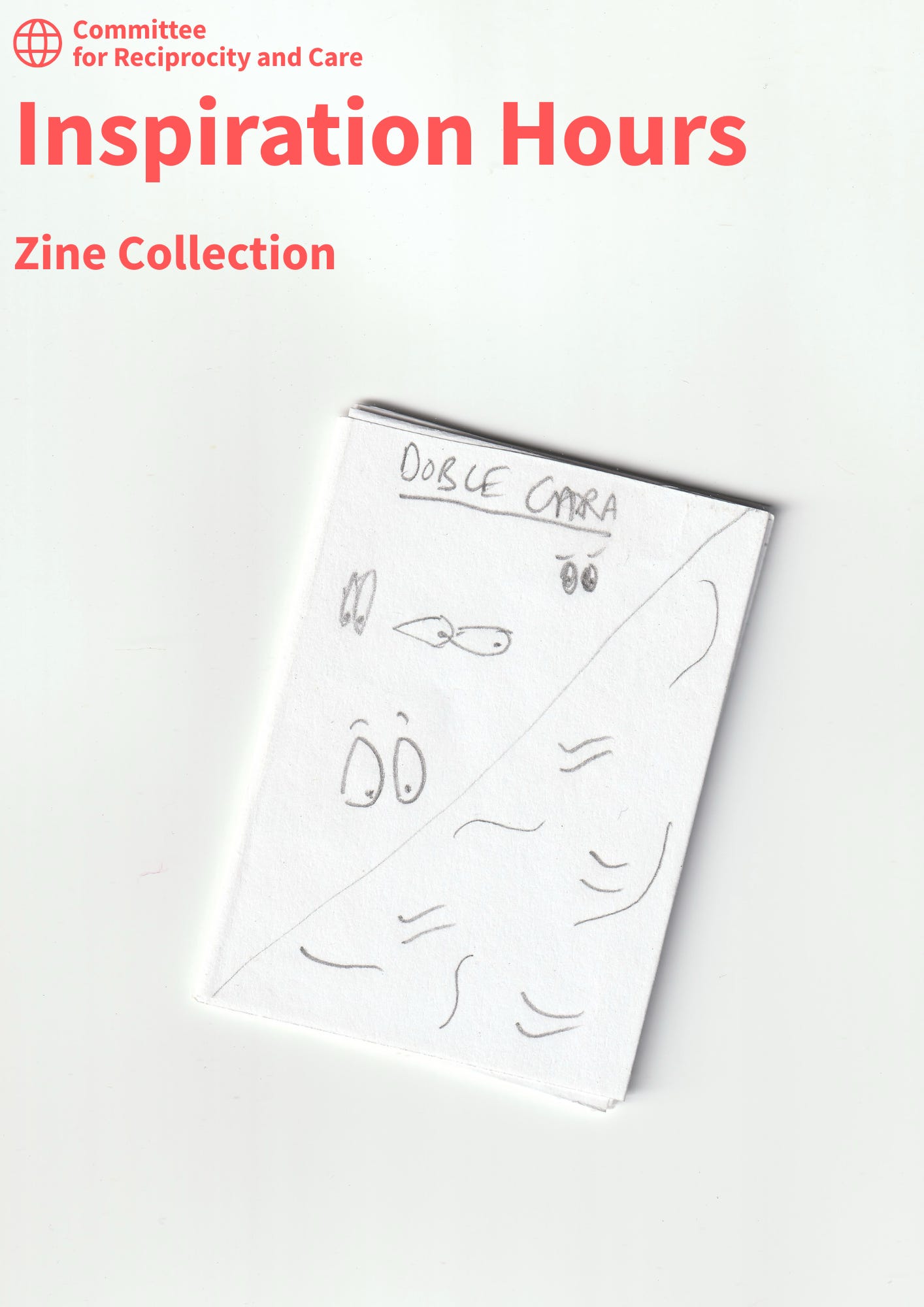
Doble Cara
AC+DC 148 Experiments for Seeing, Stories from Inspiration Hours
☀️ 30c
Queridos vecinos,
Artist, neighbor, friend, follower of CRC, Sejal came by today to do a recording of her zine. In the process we got talking about some of the themes and provocations in the pages of the zine. I started by asking about the quote from yesterday, “A communion of subjects not a collection of objects”, by Thomas Berry. The discussion could be summed up in two questions: what it is to be considered local and what is it to be transplanted.
Sejal spoke of a big infrastructure project, where, to make way for a new highway in Mumbai, a section of mangroves is being “transplanted” elsewhere. Sounds sensible, preferable to ripping them or burying them. But what does it mean to transplant? There is an entire ecosystem around and part of those mangroves that will suffer and there is an ecosystem wherever the mangroves are purportedly going to be relocated - where the mangrove may suffer. In brief, the proposal is short-sighted, PR-friendly, but a symptom of a modernist view of nature as something to be controlled, a collection of objects.
A parallel project but of a different mindset is the Victoria and Albert East Storehouse. An open archive, a working archive. It’s a big topic, but we covered the issues of museums considering their collection as treasures, objects often seized from elsewhere, and preserved for future generations. But this stance, a potential misreading of the item’s original purpose: to be used, to emit energy, to be gods, to wear, to endure, not to be hermetically sealed away. The Benin bronzes being such as example.
As you have maybe encountered Orno, the CRC, the citizen action teams, stories from pollen or swallows, I asked Sejal about such voices and stories in her work or present in the dilemmas highlighted in her zine.
We realized that numerous favorite local dishes, famously local, have a primary ingredient that is an immigrant. We thought of two obvious candidates:
Pain tomate (I feel like I hear phonetically: pan tomat), more formally pain con tomate in Castellano and in Catalan pa amb tomàquet. Such a ubiquitous offering. Yet, tomatoes are from pre-Columbian Mexico and growing wild in the Andes prior to domestication, in 16th C brought to Spain.
Arroz. Rice. Originally domesticated along the Yangtze River in China. The Moors brought it to the peninsula between 8th and 10th C. Awhile ago!
We discovered that our work operates in opposite ways but with similar purposes. Her work introduces potential foreignness for the purposes of finding familiarity, broader connection, a celebration of differences, histories, textures, colors, patterns, mindsets. My work is initially familiar until you realize you’re being led to foreign points of view, alternatives, questions, connections, a celebration of differences, histories, textures, colors, patterns, and mindsets.
The takeaway, is to listen, look with more critical consideration. Resist the quick superficial judgements. Question received framing, metaphors, nicknames and prejudice. As Saarinen guided designers to consider the next larger context, so too can we consider the context of our neighbors, strangers, food, plants, animals that we encounter. It could just be that your favorite local thing is actually a foreigner.
Sejal, artista, vecina, amiga y seguidora de CRC, se ha pasado hoy por aquí para grabar su fanzine. Mientras lo hacíamos, hemos acabado hablando de algunos de los temas y reflexiones que aparecen en las páginas del fanzine. Empecé preguntándole por la cita de ayer: «Una comunión de sujetos, no una colección de objetos», de Thomas Berry. La conversación podría resumirse como un debate sobre qué significa ser considerado «local» y qué implica ser «trasplantado».
Sejal habló de un gran proyecto de infraestructura en el que, para dejar espacio a una nueva autopista en Bombay, se está «trasplantando» a otro lugar una zona de manglares. Suena sensato, preferible a arrancarlos o enterrarlos. Pero, ¿qué significa «trasplantar»? Hay todo un ecosistema en torno a esos manglares —y que forma parte de ellos— que se verá afectado, y hay un ecosistema allí donde supuestamente se van a reubicar los manglares, donde estos también pueden verse afectados. En resumen, la propuesta es miope, favorable para las relaciones públicas, pero un síntoma de una visión modernista de la naturaleza como algo que hay que controlar.
Un proyecto paralelo, pero con una mentalidad diferente, es el Victoria and Albert East Storehouse. Un archivo abierto, un archivo en funcionamiento. Es un tema amplio, pero abordamos la cuestión de los museos que consideran sus colecciones como tesoros, objetos a menudo incautados en otros lugares y conservados para las generaciones futuras. Pero esta postura supone una posible interpretación errónea del propósito original de los objetos: ser utilizados, emitir energía, ser divinos, ser usados, perdurar, y no quedar herméticamente sellados. Los bronces de Benín
Como quizás ya conozcan a Orno, la CRC, los equipos de acción ciudadana, las historias del polen o las golondrinas, le pregunté a Sejal sobre estas voces e historias presentes en su trabajo o en los dilemas que aborda en su fanzine.
Nos dimos cuenta de que muchos platos locales, famosos por su tradición, tienen un ingrediente principal de origen inmigrante. Pensamos en dos ejemplos obvios:
El pan de tomate (creo oírlo fonéticamente: pan tomat), más formalmente pan con tomate en castellano y en catalán pa amb tomàquet. Un plato tan común. Sin embargo, los tomates son originarios del México precolombino y crecían silvestres en los Andes antes de ser domesticados, llegando a España en el siglo XVI.
El arroz. Originalmente domesticado a lo largo del río Yangtsé en China. Los moros lo trajeron a la península entre los siglos VIII y X. ¡Hace ya bastante tiempo!
Descubrimos que nuestro trabajo opera de maneras opuestas, pero con propósitos similares. Su obra introduce una posible extrañeza con el fin de encontrar familiaridad, una conexión más amplia, una celebración de las diferencias, las historias, las texturas, los colores, los patrones y las mentalidades. Mi trabajo resulta familiar al principio, hasta que uno se da cuenta de que se le está guiando hacia puntos de vista, alternativas, preguntas y conexiones ajenas, una celebración de las diferencias, las historias, las texturas, los colores, los patrones y las mentalidades.
La conclusión es escuchar, observar con mayor espíritu crítico. Resistan los juicios rápidos y superficiales. La pregunta recibió un encuadre, metáforas, apodos y prejuicios. Así como Saarinen guió a los diseñadores a considerar el contexto más amplio, nosotros también podemos considerar el contexto de nuestros vecinos, extraños, alimentos, plantas y animales con los que nos encontramos. Puede que lo que más te guste de tu localidad sea, en realidad, algo extranjero.
Historias de
Inspiration Hours
con Sejal
The creative brief for the zine is to provide simple series of instructions, prompts, questions, or activities to help our neighbors see their everyday lives anew.
El objetivo creativo de la revista es proporcionar una serie sencilla de instrucciones, sugerencias, preguntas o actividades para ayudar a nuestros vecinos a ver su vida cotidiana desde una nueva perspectiva.
Zine by Sejal
”Doble Cara”
Transcript
Co-existence between safeness, beauty, culture and so on…AND…constant hypervigilance, you are not from here, we judge you.
Coexistencia entre seguridad, belleza, cultura, etc., Y… hipervigilancia constante: si no eres de aquí, te juzgamos.A lot of misplaced anger, “go home”…AND…refugees welcome, but also, only if you fit the stereotype of what that looks like.
Mucha ira mal dirigida: «¡Vete a casa!». Y… los refugiados son bienvenidos, pero solo si encajas en el estereotipo.Whiteness, privilege, (but you’re not allowed to be privileged)…AND…A place full of progressive ideas and yet stuck.
Blanquitud, privilegio (pero no se te permite ser privilegiado). Y… Un lugar lleno de ideas progresistas, pero estancado.Take a walk and notice: 1. how someone black/brown/non/other is treated, how many of said people you see working inside the places you frequent…AND…How different it feels when you walk in another city or barrio.
Da un paseo y observa: 1. cómo se trata a una persona negra, morena, no blanca o de otra raza; cuántas de estas personas ves trabajando en los lugares que frecuentas; Y… la diferencia que se siente al caminar por otra ciudad o barrio.In Gracia (count): Count how many palestinian flags you see, count how many “tourists go home” slogans you see…AND…Count how many catalan flags you see.
En Gracia (cuenta): cuenta cuántas banderas palestinas ves, cuántas pancartas con el lema «turistas, váyanse a casa» ves; Y… cuántas banderas catalanas ves.Public statues: Look and read a little more about the public statues in the city, el barrio. 1. visit Bruc y Diagonal in front of Ancestral Bar, 2. Find one in your barri, barrio and find out more, 3. One you pass everyday.
Estatuas públicas: observa y lee un poco más sobre las estatuas públicas de la ciudad, el barrio. 1. Visita Bruc y Diagonal frente al Bar Ancestral. 2. Encuentra uno en tu barrio y descubre más. 3. Uno por el que pases todos los días.Listen: No headphones, paseo en el barrio. Try to find the: loudest sound, funniest sound, how many languages you hear, most surprising sound.
Escucha: Sin auriculares, pasea por el barrio. Intenta encontrar: el sonido más fuerte, el más gracioso, cuántos idiomas escuchas, el más sorprendente.
Thanks for reading / Gracias por leer,
[CRC]
What if things keep going exactly as they are, where are we heading?
Today’s story inspired by
Temporal Tactics by StudioCONE
☕️☕️
Si estás en Barcelona, envía un mensaje y ¡podemos tomarnos un café!
If you’re in Barcelona, send a msg, and we can go for a coffee!
ABOUT US
FIELD REPORT es el nuevo canal adoptado por CRC en colaboración con Possibility Hours y Adventuring Ventures. FIELD REPORT is the new adopted channel for CRC in collaboration with Possibility Hours and Adventuring Ventures.
 | A guest post by
|