

Futures...for Us? Eudaimonia
Notes from Technofeudalism
🌤️☁️☁️☁️☁️
Cloudy / Nublado 16c
Energy: med
Pleasantness: hi
Today, I’m going to spend some time with a diagram from the book Technofeudalism : What Killed Capitalism by Yanis Varoufakis. To understand it by trying to explain it, to myself and you. These are the words of a designer trying to understand economics and the history of capitalism. I’m going to get things wrong, going to miss important pieces, put the emphasis in the wrong place. It’s a work in progress…it is simply my current understanding.
Hoy voy a dedicar un tiempo a un diagrama del libro Technofeudalism. Para entenderlo, voy a intentar explicarlo, tanto a mí mismo como a ustedes. Estas son las palabras de un diseñador que intenta comprender la economía y la historia del capitalismo. Voy a equivocarme, voy a pasar por alto aspectos importantes, voy a poner el énfasis donde no corresponde. Es un trabajo en progreso... es simplemente mi comprensión actual.
For me, success is simple to see this diagram in motion AND in doing so, to equip us to witness it in our lives.
It is also a lot to digest. I’m not going to do it justice in one essay. There are 1000s of books on the topic and millions of important details, people, events, and facts I have missed. For me, success is simple to see this diagram in motion AND in doing so, to equip us to witness it in our lives. To be able to see the signals of it in the news, on the street, in our everyday routines. These are the elements and flows described in the large rectangle labeled, “Capitalist Sector (Figure 1)”.
También es mucho que asimilar. No voy a hacerle justicia en un solo ensayo. Hay miles de libros sobre el tema y millones de detalles importantes, personas, acontecimientos y hechos que me he perdido. Para mí, el éxito es simplemente ver este diagrama en movimiento Y, al hacerlo, equiparnos para ser testigos de él en nuestras vidas. Ser capaces de ver sus señales en las noticias, en la calle, en nuestras rutinas diarias. Estos son los elementos y flujos descritos en el gran rectángulo etiquetado como «Sector capitalista (Figura 1)».
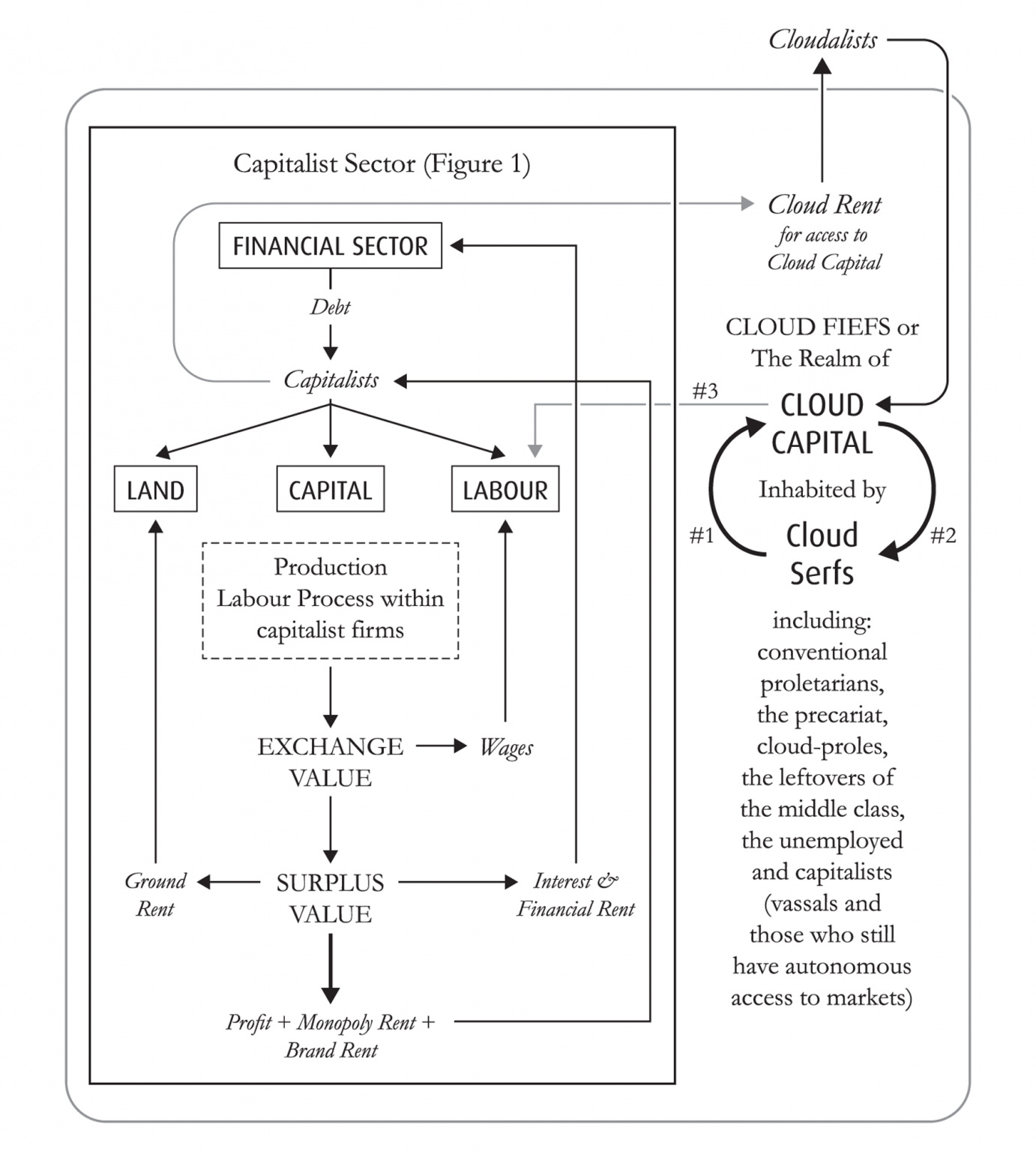
Capitalist Sector
Within boxes are these labels:
LAND
CAPITAL
LABOUR
FINANCIAL SECTOR
One way to see the flow in the diagram could be:
A person(s) has or gains access via inheritance, socio-economic class, trade, or violence to control either LAND, CAPITAL, or LABOUR or all of the above. They enclose it, making it private, take it as their own. This began ages ago pre-industrial era. We are so used to it, it can be hard to imagine a prior time.
Those enclosures produce things, services, etc, commodities, which generate:
EXCHANGE VALUE. A part of the EXCHANGE VALUE are Wages paid to the LABOURERS. We work for X
€per hour, for Zhrs, to do Y - is a kind of exchange.SURPLUS VALUE. This is portioned into:
Rent paid for the LAND, if not already owned, or to acquire more LAND.
Profit is used to compensate themselves, to grow, and to maintain their brand, to create some competitive advantage against all the other Capitalists who are engaged in the same enclosures, violence, and flows. The drive is to increase Profits while reducing Rents(costs). Pretty basic economics. To increase Profits, there is pressure to reduce Wages, Rent, and Interest. To “win” requires growth - change - because if you don’t the other capitalists will.
Interest and Financial Rent to pay back debt, which they will be required to engage in order to grow and remain competitive.
To enable continuous growth, the Capitalist borrows money from the FINANCIAL SECTOR, creating debt.
Una forma de ver el flujo en el diagrama podría ser:
Una persona o personas tienen o obtienen acceso, a través de la herencia, la clase socioeconómica, el comercio o la violencia, para controlar la TIERRA, el CAPITAL o la MANO DE OBRA, o todo lo anterior. Lo acotan, lo convierten en privado y lo toman como propio. Esto comenzó hace mucho tiempo, en la era preindustrial. Estamos tan acostumbrados a ello que puede resultar difícil imaginar una época anterior.
Esos recintos producen cosas, servicios, etc., productos básicos, que generan:
VALOR DE INTERCAMBIO. Una parte del VALOR DE INTERCAMBIO son los salarios pagados a los TRABAJADORES. Trabajamos por X € la hora, durante Z horas, para hacer Y: es una especie de intercambio.
VALOR AÑADIDO. Se divide en:
El alquiler pagado por la TIERRA, si aún no se posee, o para adquirir más TIERRA.
Las ganancias se utilizan para compensarse a sí mismos, para crecer y mantener su marca, para crear alguna ventaja competitiva frente a todos los demás capitalistas que se dedican a los mismos cercados, violencia y flujos. El objetivo es aumentar las ganancias y reducir los alquileres (costos). Es economía bastante básica. Para aumentar los beneficios, existe presión para reducir los salarios, los alquileres y los intereses. Para «ganar» se requiere crecimiento, cambio, porque si no lo haces, lo harán los demás capitalistas.
Intereses y rentas financieras para pagar la deuda, a la que se verán obligados a recurrir para crecer y seguir siendo competitivos.
Para permitir un crecimiento continuo, el capitalista pide dinero prestado al SECTOR FINANCIERO, creando deuda.
FLOW
It is critical to imagine this flow chart in motion, in order to understand the motivations and behaviors within it. If you imagine it as a cycle growing larger and larger, the reinforcing forces, like a flywheel, of Profit and Debt drive it forward. Like opposing polarities pulling two batteries together. To grow requires more Profit to payback ongoing borrowing and debt. A vicious cycle.
More profit requires driving down the costs of LAND and LABOUR, Rent, Interest, etc. This is why we hear in the news so often about GDP or GDP per capita - how much is the economy growing. Or about interest rates or wages. Their are metrics of the growth of this cycle.
Once enclosure or privatization of LAND, CAPITAL, or LABOUR began, it triggered a wave disrupting the prior ways of life. It also triggered the war and campaigns to control the narratives adopted by culture and politics. What is good? What is just? What is right? What is legal? What is the measure of success? What is winning? What are we meant to be doing? What is worth? What is value?
Es fundamental imaginar este diagrama de flujo en movimiento para comprender las motivaciones y los comportamientos que lo conforman. Si lo imaginamos como un ciclo que se hace cada vez más grande, las fuerzas reforzadoras, como un volante, de los beneficios y la deuda lo impulsan hacia adelante. Como polaridades opuestas que atraen dos baterías entre sí. Para crecer se necesitan más beneficios para amortizar los préstamos y la deuda en curso. Un círculo vicioso.
Para obtener más beneficios es necesario reducir los costes de la TIERRA y la MANO DE OBRA, los alquileres, los intereses, etc. Por eso oímos tan a menudo en las noticias hablar del PIB o del PIB per cápita, de cuánto está creciendo la economía. O de los tipos de interés o los salarios. Son métricas del crecimiento de este ciclo.
Una vez que comenzó el cercado o la privatización de la TIERRA, el CAPITAL o la MANO DE OBRA, se desencadenó una ola que alteró las formas de vida anteriores. También desencadenó la guerra y las campañas para controlar las narrativas adoptadas por la cultura y la política. ¿Qué es bueno? ¿Qué es justo? ¿Qué es correcto? ¿Qué es legal? ¿Cuál es la medida del éxito? ¿Qué es ganar? ¿Qué se supone que debemos hacer? ¿Qué vale la pena? ¿Qué es el valor?
Ok. Vale?
Note, it doesn’t have to be this way! Worth saying. Jason Hickel’s book Less is More talks about other futures. See Futures for Us, pt 5 where I talk a bit about that book.
It gets worse…será peor!
The Cloud
Enclosing ALL of this, is the CLOUD. The technological structure within which this cycle we just described occurs. It is the rounded corner rectangle in the diagram. There are some elements to describe.
Todo esto lo engloba la NUBE. La estructura tecnológica en la que se produce el ciclo que acabamos de describir. Es el rectángulo de esquinas redondeadas del diagrama. Hay algunos elementos que describir.
CLOUD FIEFS
CLOUD CAPITAL - #2 Cloud-capital modifies the desires, beliefs and propensities of cloud-serfs - including their consumer choices. #3 Cloud-capital also speeds up the work rate of waged labour within the capitalist
CLOUD Serfs - #1 Cloud-serf, unpaid labour helps reproduce cloud capital.
Cloud rent
Cloudalists
Maybe you remember the term fiefdom? If fiefdoms were lands under some control then later enclosed under capitalism, CLOUD FIEFS similarly are domains, platforms, technological “lands” under some control. Again this is a huge topic. But its sufficient to get the idea that now large swaths of the “internet” are not privately owned platforms. Meta, Amazon, Google, Alexa, Tesla are some examples. Unlike previous enclosures charging rent to access or work the “land”, we are typically given free access to these CLOUD FIEFS. Why? You probably know the phrase, “If there is no product, you are the product”. The other madness is how the algorithms train us to train them to leverage our behavior even more.
On these platforms, we as users or customers, create, consume, purchase, and do all sorts of things that generate value. Our user behavior, our stats, our data, a % of our purchases, etc etc. Its an endless source of innovation. But essentially this is CLOUD CAPITAL. Not only that, but on many of these platforms we were “invited” to create, to post, to share, to build, to edit, to labor - for FREE!! That makes us CLOUD Serfs. The insane genius of Technofeudalism is the exponential growth of the capitalist cycle they’ve created, they own, and we participate in that reproduction - for FREE!
Now, if you have a store on Amazon, or sell things or services, or a platform business that only functions if the platform functions - using AWS, etc, you have to pay rent to be on that platform. Some portion of the money you make, your profits, goes to pay the fee, the subscription or whatever agreement it is. That is CLOUD rent.
It is the capitalist sector with its vicious cycles now exponentially amplified and grown via our free participation. And worse, these cycles are all enclosed and controlled by a very small number of people - the Cloudalists. Bezos and Musk being the most infamous at the moment.
¿Quizás recuerdes el término «feudo»? Si los feudos eran tierras bajo cierto control que posteriormente quedaron encerradas bajo el capitalismo, los CLOUD FIEFS son de manera similar dominios, plataformas, «tierras» tecnológicas bajo cierto control. Una vez más, se trata de un tema muy amplio. Pero basta con entender que ahora gran parte de «Internet» no son plataformas de propiedad privada. Meta, Amazon, Google, Alexa y Tesla son algunos ejemplos. A diferencia de los cercados anteriores, que cobraban un alquiler por acceder o trabajar la «tierra», normalmente se nos da acceso gratuito a estos FEUDOS EN LA NUBE. ¿Por qué? Probablemente conozcas la frase «Si no hay producto, tú eres el producto». La otra locura es cómo los algoritmos nos entrenan para que los entrenemos a ellos para aprovechar aún más nuestro comportamiento.
En estas plataformas, nosotros, como usuarios o clientes, creamos, consumimos, compramos y hacemos todo tipo de cosas que generan valor. Nuestro comportamiento como usuarios, nuestras estadísticas, nuestros datos, un porcentaje de nuestras compras, etc. Es una fuente inagotable de innovación. Pero, en esencia, esto es CAPITAL EN LA NUBE. No solo eso, sino que en muchas de estas plataformas se nos «invita» a crear, publicar, compartir, construir, editar, trabajar... ¡GRATIS! Eso nos convierte en siervos de la NUBE. La locura genial del tecnofeudalismo es el crecimiento exponencial del ciclo capitalista que han creado, que les pertenece y en cuya reproducción participamos... ¡GRATIS!
Ahora bien, si tienes una tienda en Amazon, vendes productos o servicios, o tienes un negocio de plataforma que solo funciona si la plataforma funciona (utilizando AWS, etc.), tienes que pagar un alquiler para estar en esa plataforma. Una parte del dinero que ganas, tus beneficios, se destina a pagar la cuota, la suscripción o cualquier otro acuerdo que tengas. Eso es el alquiler de la NUBE.
Es el sector capitalista con sus círculos viciosos ahora amplificados y crecidos exponencialmente a través de nuestra libre participación. Y lo que es peor, estos ciclos están encerrados y controlados por un número muy reducido de personas: los «cloudalistas». Bezos y Musk son los más infames en este momento.
Grim, no? ¿Sombrío, no?
An Escape?
I mildly panicked while reading this book and rushed to the end to seek his proposals for what we can do. Below are my quick summaries of his speculations, actually from another book called Another Tomorrow. This is the from the last chapter of Technofeudalism titled Escape. I’ve written them in reverse order from how they’re written in the book. This way it starts with the big idea and then goes into details, vs building up to the big idea.
Mientras leía este libro, sentí un ligero pánico y me apresuré a llegar al final para buscar sus propuestas sobre lo que podemos hacer. A continuación, presento mis resúmenes rápidos de sus especulaciones, que en realidad provienen de otro libro titulado Another Tomorrow. Esto es del último capítulo de Technofeudalism, titulado Escape. Los he escrito en orden inverso al que aparecen en el libro. De esta manera, comienza con la idea principal y luego entra en detalles, en lugar de ir construyendo la idea principal.
Goals:
Achieve eudaimonia1, “in Aristotelian ethics, the condition of human flourishing or of living well. The conventional English translation of the ancient Greek term, “happiness,” is unfortunate because eudaimonia, as Aristotle and most other ancient philosophers understood it, does not consist of a state of mind or a feeling of pleasure or contentment, as “happiness” (as it is commonly used) implies. For Aristotle, eudaimonia is the highest human good, the only human good that is desirable for its own sake (as an end in itself) rather than for the sake of something else (as a means toward some other end).” 2
Alcanzar la eudaimonia, «en la ética aristotélica, la condición de prosperidad humana o de vivir bien. La traducción convencional al inglés del término griego antiguo, «felicidad», es desafortunada porque la eudaimonia, tal y como la entendían Aristóteles y la mayoría de los filósofos antiguos, no consiste en un estado mental o un sentimiento de placer o satisfacción, como implica la palabra «felicidad» (tal y como se utiliza comúnmente). Para Aristóteles, la eudaimonia es el bien humano supremo, el único bien humano deseable por sí mismo (como fin en sí mismo) y no por otra cosa (como medio para alcanzar otro fin)».Re-establish a commons3 “are the cultural and natural resources accessible to all members of a society, including natural materials such as air, water, and a habitable Earth. These resources are held in common even when owned privately or publicly. Commons can also be understood as natural resources that groups of people (communities, user groups) manage for individual and collective benefit.”4
Restablecer los bienes comunes «son los recursos culturales y naturales accesibles a todos los miembros de una sociedad, incluidos los materiales naturales como el aire, el agua y una Tierra habitable. Estos recursos son comunes incluso cuando son de propiedad privada o pública. Los bienes comunes también pueden entenderse como recursos naturales que grupos de personas (comunidades, grupos de usuarios) gestionan en beneficio individual y colectivo».We can use their own technology against them / Podemos usar su propia tecnología en su contra:
Cloud mobilization5
Target a cloudalist through global action, starting with Amazon, or other examples:
General strike, no work days, boycotts, No buy days
Scott Galloway’s recent unsubscribe campaign (albeit against ICE but there is a bigger message here)
It must be big / Debe ser grande6
He summarizes parts from Another Now, a speculative fiction, an alternative present. In it he explores what if Occupy Wall Street had succeeded? / Resume partes de Another Now, una ficción especulativa, un presente alternativo. En ella explora qué habría pasado si Occupy Wall Street hubiera tenido éxito.
If the cloud and the land were a commons / Si la nube y la tierra fueran bienes comunes:
We could institute Citizen’s assembly, “a group of people selected by lottery from the general population to deliberate on important public questions so as to exert an influence”7
Podríamos instituir una asamblea ciudadana, «un grupo de personas seleccionadas por sorteo entre la población general para deliberar sobre cuestiones públicas importantes con el fin de ejercer influencia».
If we democratize money / Si democratizamos el dinero:
The central bank would issue to everyone, the equivalent to a universal basic income with interest. It would be a small amount, but sufficient to break the cycle of work, profit, debt. He also proposes a tax plan and ways to handle investments in ways to respond to being in the commons and thwart a relapse into the vicious cycle of capitalism.
El banco central emitiría a todos el equivalente a una renta básica universal con intereses. Sería una cantidad pequeña, pero suficiente para romper el ciclo de trabajo, beneficio y deuda. También propone un plan fiscal y formas de gestionar las inversiones para responder a la situación de los bienes comunes y evitar una recaída en el círculo vicioso del capitalismo.
If we democratize companies / Si democratizamos las empresas:
A bit like cooperatives. Everyone gets a non-transferrable share, a single vote. Because the company operates within more of a commons environment, the pressures of the capitalist vicious cycle are not present, growth is not the imperative, the wellbeing of society is the imperative.
Un poco como las cooperativas. Todos obtienen una participación intransferible, un solo voto. Dado que la empresa opera en un entorno más comunitario, no existen las presiones del círculo vicioso capitalista, el crecimiento no es lo imperativo, sino el bienestar de la sociedad.Pay could be determined more in a way like Eurovision where there is voting, governance of the voting, transparency and representation.
La remuneración podría determinarse más bien al estilo de Eurovisión, donde hay votaciones, gobernanza de las votaciones, transparencia y representación.
Phew! 😓
I hope that helps you wrap your arms and mind around this big topic. It helped me to write to you about it. PLEASE ask questions in the comments.
Thanks for reading. See you tomorrow.
Espero que esto te ayude a comprender mejor este amplio tema. A mí me ha ayudado escribirte sobre ello. Por favor, haz preguntas en los comentarios.
Gracias, nos vemos mañana.
[sgp]
If you appreciate this episode, please support my work by leaving a small tip using the “Invite me for a coffee” button. If you’re in Barcelona, let me know, and we can actually go for a coffee! ☕️🍷🍺
Si te ha gustado este episodio, te agradecería que apoyaras mi trabajo dejando una pequeña propina mediante el botón “Invítame a un café”. Si estás en Barcelona, avísame y tomamos un café. Gracias por leer.
Possibility Hours : FIELD REPORT
FIELD REPORT is the storytelling channel of Possibility Hours, a creative offering from my company Adventuring Ventures. It began as a podcast, and now a newsletter. FIELD REPORT’s goal is to reframe signals of external changes into opportunities for internal change. I want to harness the abundance of knowledge generated daily to bolster our readiness to change ourselves. FIELD REPORT es el canal narrativo de Possibility Hours, una propuesta creativa de mi empresa Adventuring Ventures. Comenzó como un podcast y ahora es un boletín informativo. El objetivo de FIELD REPORT es replantear las señales de cambios externos como oportunidades para el cambio interno. Quiero aprovechar la abundancia de conocimientos que se generan a diario para reforzar nuestra disposición al cambio.
Technofeudalism, pg 213
echnofeudalism, pg 212
p209
p207