

How to : See Each Other
AC+DC 105
🌤️ 18c
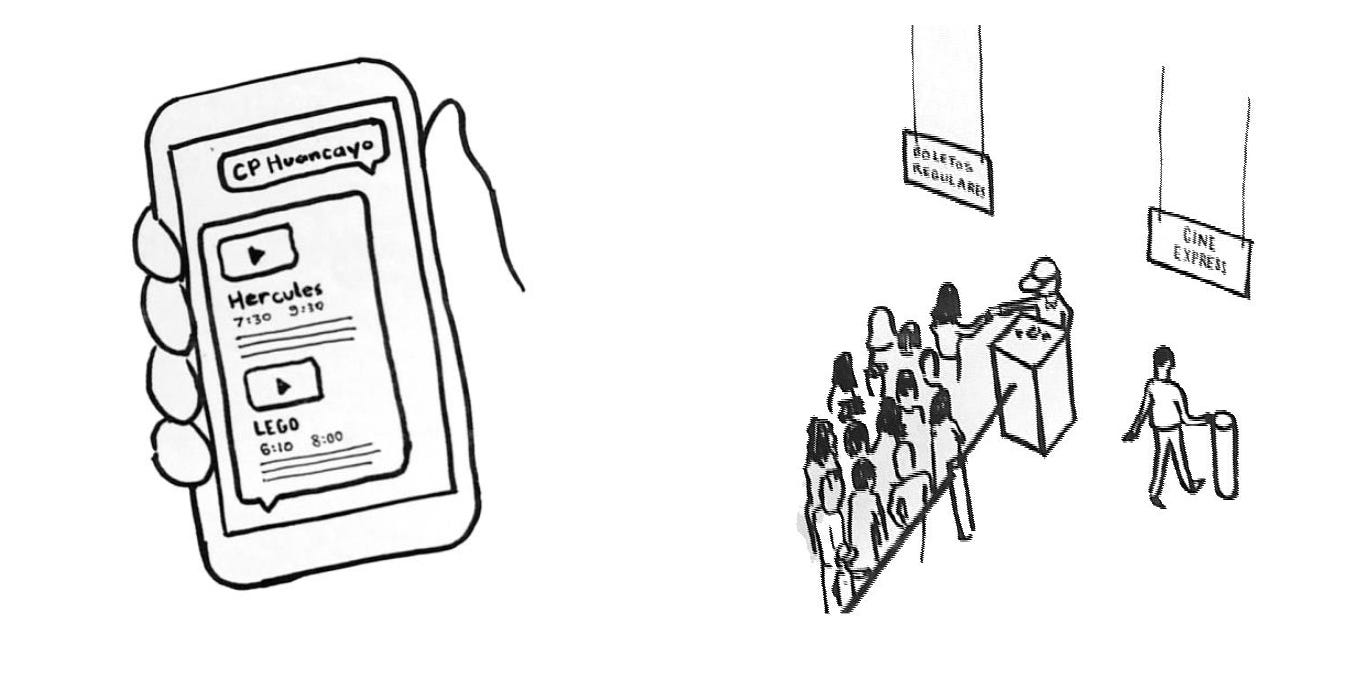
The CFO and CMO of Peru’s largest cinema chain, sat in her office in Lima. In a few minutes, she would walk into a conference room and join five of her colleagues for a presentation by a team from IDEO. In response to a rapidly-changing competitive landscape, the Company had hired IDEO several months prior to assist with a redesign of the movie-going experience it offered its customers. During the meeting the IDEO team would present their emerging vision for the future of the Company - a vision they planned to prototype in one of the Company’s most popular theaters.
Thus begins the Harvard Business School Case Study1 about the work of my team at IDEO - about human-centered design - in 2014. A team from HBS had traveled to Lima to shadow us for the 12 weeks of the project. Since it’s publication, it’s a case study still taught today in many business schools around the world. There is a multimedia component for the case that includes numerous videos of me and the team doing our work. As such, we are not anonymous. Once, while visiting HBS upon the case’s first teaching, students peeped and prodded each other and one finally broke the silence asking, “Are you the guy from IDEO?” I am still asked to visit classes, online or IRL, when the case study arrives on the curriculum. After 10+ years of doing this it’s still a unique experience because the case study format of education, in the amphitheater rooms of business schools, is quite different from the messiness of studios at design schools. It’s like visiting another planet with its own language, culture and norms.
At first this was fun but has become a bit frustrating. Despite the lessons of the case study being well known, being lionized, copied, or deemed too expensive, too slow, stale and worn out, the methods and mindsets while thoroughly debated, blogged, podcasted, dismissed, built-upon, etc, they still seem a bit of a mystery or enigma. I still come across podcasts debating it and leave me wondering whether the critic is well-practiced or just well-read. Nonetheless, no doubt it’s dated.
To bring the tools to life, to bring back the fun, and to demonstrate its relevance and my point that its not the process that matters, I have students try it out on each other. I want them to feel it in their body, their heart, their ego - that it’s more important to be humble, to see and listen to your audience, to bring your tools (whatever they may be), and be ready to iterate.
I’ve begun to demonstrate or have students try out some aspect of the methods. I’ve distilled what I consider to be some critical takeaways that continue to be useful and I presume will be useful no matter the advancements in technology, design, or process. I wrote about a session with business executives at IESE Business School titled Futures for Humility where they practiced, in an hour, a few of these tools, learned to listen and see each other, to be humble, to be tangible and to iterate.
It’s also worth mentioning that the prompts below can be used whether designing from tomorrow, the near future or longer-term. These are still questions to ask yourself.
For a recent online program with students at Ivey Business School in Canada, I shared the takeaways in three key prompts:
What are you trying to do?
Oversimplified maybe, but essentially this can break down into two options.
Improve on something you are already doing. I categorize this as convergent activity. You’re trying to narrow down, optimize, become more efficient, etc. There are already tons of tools for optimization. These are worthy tasks, important tasks, but not a good fit for the innovation tools we’re hear to discuss.
Do something different. I categorize this as divergent activity. You’re trying to branch out from what you know. Many reasons why you might do this - new customer group, new product, new feature, new service, new region, etc. With this divergence comes the discomfort of being a beginner. Your expertise, ego, leadership, whatnot will do what it can to leap to answers and solutions. Beware! This is a great fit for these innovation tools.
Who might you learn from?
Two groups to identify. Often labeled as outliers, I prefer to describe them as those with expertise and those without expectations. I suggest to start small and get out of the office. Never start with a survey. Do you like surveys? Me neither.
Who are the experts that have found work-arounds for the “doing something different” you want to learn about? Those people are quite mindful and great for interviews because they knew enough to know it could be better and went about trying to make it better. So, to repeat, not just experts, but experts who have attempted their own improvements. So many lessons from these folks.
Who are the people who have never done this? Beginners and kids are common examples. They bring with them their world of best-in-class experiences and an expectation that this new thing could be just as great. They often compare the new thing to some good experience in their lives, “why can’t this be just like an XYZ?” These possibilities can become provocations. Yes, why can’t it be like that?
How might you learn from them?
I have two simple points about research methods.
You can learn a lot from 5 people when using the above criteria for choosing them. I mean talking to them in person, in context, visiting them where the new thing may happen - aka qualitative research. You can certainly learn enough to synthesize some hypothesis about their needs and pains. Certainly enough to conduct a quantitative research - to understand how big it might be, where might it be, and more. Loop back to qualitative when you have a sacrificial concept. Qualitative for the stories, quantitative for the scale. Back and forth. I defer to experts here. This is an enormous topic. But if you’re new, this will get you going.
Always bring sacrificial concepts. I like to describe these as something that takes less then an hour or less than €100. Just enough to convey an idea tangibly - a series of rough sketches is enough. The key reason is that your ego won’t be attached to its success. It won’t be precious. But it will be concrete enough that participants see opportunities. Too polished and they see blemishes, revert to polite people-pleasing no matter how disinterested they may be - especially when in-person.
I hope that’s helpful. It’s meant as a kind of table setting for a discussion, “Here are my high-level guidelines. Let’s discuss.” So far, so fruitful. Invariably this short list unlocks questions and reflections. That’s the goal.
Not a process, tools.
Diverging vs converging.
Hackers and beginners.
Bring sketches, check your ego.
Below is a note I wrote recently on LinkedIn in response to a question to me about process and methods. I’m sharing it as an example of my criticism of those selling a process, just as IDEO had done for so many years, to the point of luring in the HBS team to shadow us, and perpetuate further in business schools the mythology that this mindset and toolset was a process.
Even the HBS website says, “The case describes IDEO, one of the world’s leading design firms, and its human-centered innovation culture and processes. It is an example of what managers can do to make their own organizations more innovative.“ I just noticed this, but at least it says processes, plural. Not a pipeline, not the next silver bullet panacea - which was a common feeling during the max hype of design thinking.
To package as a process is an abstract aberration of education. The process packaging is for selling. The sooner this gets unpacked and people realize it is an ever evolving set of tools, a toolset open to all - we will stop running people thru a process grinder and instead get better at seeing and listening to each other’s ingenuity.
When I was consulting (I have shifted to convening vs consulting) I set up a way for clients to subscribe to me. There were different levels of engagement, all tuned to help the client with what they were trying to achieve. I had learned at IDEO that selling method was a trap. An appealing, security-bestowing trap. It’s what plagues the term design thinking to this day, the many declarations of its racism, irrelevance, obsolescence. I would often unpack that there was indeed no method no process only an ever evolving set of tools to deploy based on what we discovered and the decision making culture of the org.
In short, bespoke. Never the same.
The struggles were the common thread. Clients - global corporations, governments, startups - having become alert to a problem or a success, asked themselves what to do next. Invariably that meant trying to do something new. In this, it meant a new venture.
Broadly speaking the toolset draws from a wide set of disciplines (art, design, science, econ) that commonly get packaged into “design thinking“, “human-centered design”, and “strategic foresights”. Those titles are like galaxies, clouds of discipline dust. The closer you examine the more complex it gets. On this, I’d say post-disciplinary.
So. No specific method. Just focus on fit. What are you trying to do, how do you see it, how can I/we be of help to get you a bit further. Participatory. Do together.
The name Adventuring Ventures is a suggestion, a way of proceeding. Adventure as a verb, adventuring, sets a tone of rigor with intuition and venture, sets a tone of permission that we are informed beginners and thus should include in our list of assumptions to examine, the economics that almost surely are a silent chauffeur or elephant in the room. Naming these things allowed the personalities of the clients, the teams, the organization to be on the table.
If I was forced to name this method: design therapy.
Thank you for spending some time here. Gracias por leer.
See you tomorrow, Nos vemos mañana,
[sgp]
How To : Backlog
How to eliminate these wordsCompletedHow to critique yourself
How to find purpose - further iterations on Monday sketches. To enact them. Make sketches of planning it out.CompletedHow to change course
How to make a zine.CompletedHow to fold paper
How to fold paper more than 7 times NEW
How to make it possible
How to be happy - Trevor Noah podcast w Albert Brooks
How to community -23 thingsHow to give feedback
How to think in public - this is now a diary
How to read
How to be a flea
How to be a tree
How to be a circling dove
How to be high above
How to be with thee
How to be just me
How to pause
How to plate beans and sausage
How to make a bed
How to set a table
How to surf a wave
How to carve an ess on ice
How to dress when you can see your breath
How to fry an egg
How to poach one or two
How to listen
How to find everyone is ingenious
How to typo
How to lead creatively
How to creatively lead
How to model
How to prototype
How to letter
How to smile with your eyes
How to be excited and talk too much
How to travel alone
How to dance in the morningHow to be thereHow to not
How to make a list
How to make a flow chart
How to design a space for contemplation
How to tread water
How to befriend a medusa
How to go with the wind
How to climb a hill
How to recover
How to run downwind
How to make a bird feeder
How to remove a stump
How to sheetrock
How to detail a corner
How to be loved
How to say I love you
How to dance in the morning - sketch of footworkBe a birdRun a Possibility Hours monthly schedule
SeeHow to
Do nothing
Get rid of a migraine
Be abundant
Shed scarcity
Be a tree
Keep it going
Slow down
Catchup - Instead of the “knowing” someone by following their socials, I’m reaching out to people directly, old school, to catch up. IN PROGRESS
Find your superpowerConvene a citizen assembly, based on some resource
Decidim how it works. Make a drawing of the process.Participate in Monthly city council meetings. Share the schedule. Look for the posters on doorways. Signup for emails.Actively commit to daily creation
Reminder
See. There. U found it! U can do it.
It’s ok to not know what you’re going to do to day.
It’s ok because you remember to have faith in yourself and give yourself permission to just show up. You’ll create something. Good or bad. You will create something.
U can do this. Keep focus on joy. The energy of fun. Do what you WANT to spend time doing vs feel obligated or driven to do because of some external pressure or norm or conformity or comparison.
Thanks for being here.
Si te gustó este episodio, por favor, apoya el trabajo dejando una pequeña propina usando el botón “Invitar a un café”. Si estás en Barcelona, envía un mensaje y ¡podemos tomarnos un café!
If you appreciate this episode, please support the work by leaving a small tip using the “Invite for a coffee” button. If you’re in Barcelona, send a msg, and we can actually go for a coffee! ☕️🍷🍺
ABOUT US : Committee for Reciprocity and Care (CRC) : Possibility Hours : FIELD REPORT
FIELD REPORT es el nuevo canal adoptado por CRC en colaboración con Possibility Hours y Adventuring Ventures. FIELD REPORT is the new adopted channel for CRC in collaboration with Possibility Hours and Adventuring Ventures.
The case describes IDEO, one of the world's leading design firms, and its human-centered innovation culture and processes. It is an example of what managers can do to make their own organizations more innovative. In reaction to a rapidly changing competitive landscape, a team of IDEO designers have been hired by Cineplanet, the leading movie cinema chain in Peru, to reinvent the movie-going experience for Peruvians. Cineplanet wishes to better align their operating model with the needs and behaviors of its customers. Please note: This case study includes mandatory video elements, which are integrated into the pre-class assignment for students and the classroom teaching plan for instructors. Information on how to access and use these multimedia components is included in the Teaching Note. https://www.hbs.edu/faculty/Pages/item.aspx?num=48085